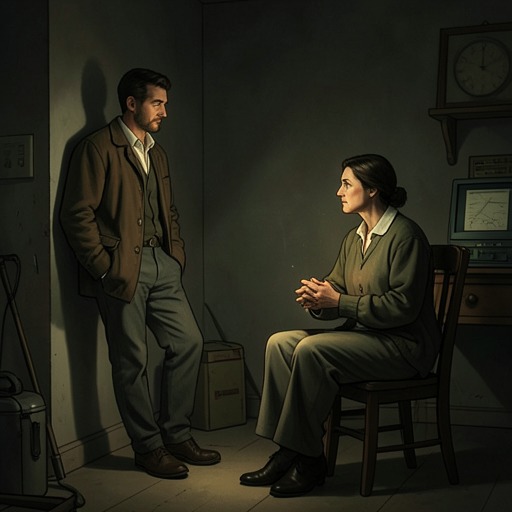
Long-term relationship between Jean Farel and Françoise Merle
Les Choses humainesJean Farel and Françoise Merle’s nearly eighteen-year relationship is a secret parallel life shaped by real attachment, deferred promises, and Jean’s refusal to choose a shared future over the protection of his family and the preservation of his public image. Françoise waits for a commitment that never comes; when she attempts suicide, the crisis exposes how deeply the arrangement has exhausted her and ends with her telling Jean to leave.
Origins and the promise of a shared life
Jean meets Françoise three years after the birth of his son, Alexandre Farel, in the corridors of Ambition pour tous, an association Jean founded to help students from disadvantaged backgrounds enter journalism schools. Françoise is a distinguished print journalist: a former reporter and senior newspaper editor, and the recipient of the Albert-Londres Prize in the 1970s for her reporting on Les Oubliés de la cité Palacio in Seine-Saint-Denis. When the relationship begins, she is beautiful, cultivated, and generous; she has recently celebrated her sixty-eighth birthday by the time the story describes their long-established double life.
For years, Jean assures Françoise that they will eventually be together. She does not marry or have children, and waits for him to make good on that promise. But Jean does not divorce. He presents the decision chiefly as a sacrifice for Alexandre: he considers his son exceptionally precocious and brilliant, yet immature in private, and tells himself that a stable family framework will protect him. The rationale sits beside a less flattering truth: Jean’s interest in his wife, Claire Farel, has long been largely confined to family life, but he still cannot bring himself to end the marriage.
The relationship is therefore neither a casual affair nor a completed partnership. Jean says he loves Françoise and feels bound to her by ties so deep that breaking them would damage him; at the same time, he knows that their future has been indefinitely postponed. The contrast between emotional dependence and practical refusal defines their shared life: Françoise is indispensable to him in private, but he does not give her the acknowledged place that would make a life together possible.
Secrecy, status, and the public marriage
Jean’s hesitation is also bound up with image. He believes that appearing publicly with a woman close to his own age would make him seem older and damage his social standing. By contrast, he has used Claire and their family as a carefully managed public tableau: magazine profiles show him as a faithful husband, a devoted father, and a man who respects his younger wife’s work. Claire understands that this presentation can benefit her career and participates in it, even as their separation later makes the marriage’s public appearance increasingly precarious.
Françoise encounters those family portraits in the press. They make visible the difference between the relationship Jean promises her and the one he performs for the public. In moments of distress, she breaks through the theatrical arrangement, angrily telling him that she can no longer bear the role he has assigned her and accusing him of seeking a mother rather than a wife. She leaves by slamming the door. These quarrels become more frequent, while Jean treats the conflict as part of an intimate vaudeville whose performance he cannot—or will not—bring to an end.
The tensions sharpen when Jean receives a major public honour at the Élysée Palace. He asks Françoise to attend, but she refuses: she has no wish to watch him receive his medal to applause, or to see Claire praised as the woman without whom he would never have succeeded. Claire has promised to be there so as not to humiliate him. Jean answers Françoise by calling his marriage a social shop window, a description that confirms his cynicism about its public function without changing his conduct. Françoise’s refusal is not simply a rejection of ceremony; it is a refusal to stand silently inside the fiction that gives Claire public recognition while keeping her own place hidden.
Professional decline and a breach of trust
Françoise’s private insecurity is compounded by her professional decline. After rising through journalism from reporter to editor-in-chief and deputy director, she fails to secure the newspaper’s directorship. She becomes an editorial adviser, a vague title that conceals an unofficial sidelining and the approach of a retirement she dreads. For two years she has been depressed and taking anti-anxiety medication as she tries to withstand the sense of being pushed out while still capable and effective.
A newspaper profile of Jean becomes another rupture. He learns that Françoise’s paper has published material that he regards as a betrayal, and calls her. She says she had not seen the piece, discovered it at the same time he did, and did not know that the production schedule had been changed without her. She had, she admits, already worried that insisting on the profile would be counterproductive. Jean rejects her explanation and tells her that she has betrayed him. When she insists she was not aware of the change, he turns her loss of influence at the newspaper into an insult, saying she is worth no more than an intern and adding a sexualized taunt.
Françoise falls silent. Jean immediately regrets what he has said, waits, and apologizes, explaining that he is overwhelmed and cannot trust anyone in his profession. His apology does not undo the insult or the larger imbalance: her declining authority at work has become a weapon in a conflict with the man whose public career she has long had to accommodate. The episode shows how their private bond is entangled with the professional worlds that formed it, and how Jean’s fear of betrayal can eclipse the care he claims to feel.
Suicide attempt and the end of the arrangement
At the Élysée reception, Jean receives an anonymous text saying that Françoise has attempted suicide. He freezes amid the ceremony and imagines himself collapsing in public; then he regrets how harshly he has treated her. Seeing Claire in the dress he had asked her to wear, he thinks that Françoise is the only woman he has ever loved and that she has tried to die because of him. Yet the public event continues. Jean cannot leave before the President’s appearance and the reception held in his honour, so he puts his phone away and carries on with the ceremony while fearing for Françoise.
When Jean later sees her, his anger has vanished. He asks what happened, approaches, strokes her hand, and apologizes for having been brutal and stupid. Françoise does not answer his attempted explanation. She has built her life around freedom and independence, and understands that she must leave him for the sake of her mental and physical survival: she has already been carried beyond her limits. His tenderness and declaration of love arrive after the crisis, but do not alter the conditions that brought her to it.
She draws back when he moves as though to kiss her and tells him it would be better if he left: he should go and not return. Jean pauses, then agrees. He recognizes the public and professional consequences of her attempt, imagining that others will question her ability to work and that sick leave will lead to her dismissal. He believes that, this time, he cannot save her from that outcome. Françoise asks him to take care of Claude, the dog he gave her and the best thing he has done for her; for everything else, she dismisses him angrily. The request preserves one concrete kindness amid the rejection, but it does not reopen the relationship.
What the relationship reveals
The relationship’s central contradiction is that Jean’s attachment is sincere while his promises remain unsupported by decisive action. He fears losing Françoise, yet keeps her in the shadows to protect a family structure he says is necessary for Alexandre and an image that helps him retain status. His public marriage can be dismissed as a display, but that display has real consequences: it gives Claire an acknowledged role and leaves Françoise to encounter their arrangement through newspaper photographs and repeated delays.
Françoise’s final refusal marks a change from waiting for Jean to choose her to insisting on the conditions necessary for her own survival. The story does not present the suicide attempt as a reconciliation or as proof that Jean’s late remorse can repair the relationship. Instead, the sequence moves from his apology to her withdrawal, from his declaration of love to her demand that he go, and from his long-standing promise of a future together to a practical severance. Their bond remains emotionally consequential, but its ending exposes the cost of treating intimacy as something that can be preserved indefinitely without giving it a public or shared life.